Friday, September 22, 2006

ACCESS on VSAT - A clever solution from our friends in the UK

Over in England, our friends at Vortex have been working with the BBC on some trials using the Access over VSAT. Jon Clark takes up the story…

"One of the impacts of so much on-demand radio is that the stations themselves need to play to their one great strength, live content. Being one of the world’s largest providers of on-demand services, the BBC is only too aware of this. They have therefore launched the “Edge” project which aims to look at new methods for linking live to OB vehicles, including alternatives to the traditional UHF radio car. They already make extensive use of the Matrix over GSM and are interested by the prospect of going a step further, providing very high quality OB audio, including the possibility of stereo.
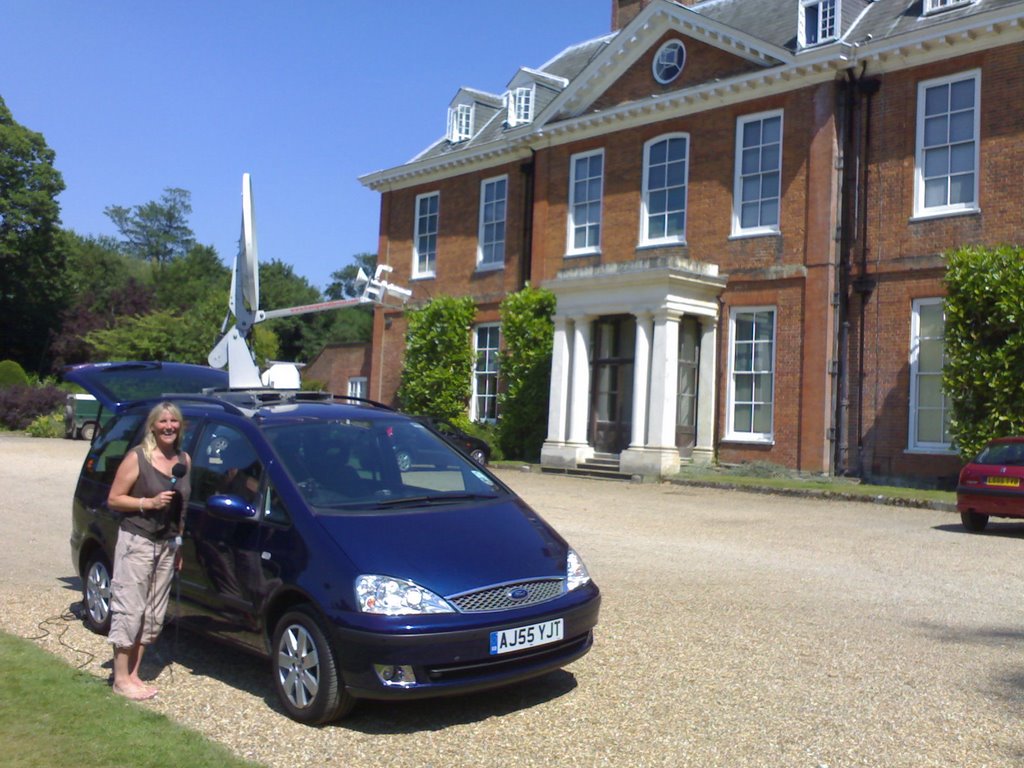
To that effect, they have built three experimental vehicles, all kitted out with self-seeking VSAT dishes. Once the vehicles are commissioned, they will travel around the UK spending 2 weeks at one of their local radio stations before being moved onto the next. This way, everyone will get a chance to see the technology, use it in the real world and provide feedback to the project.

The vehicles themselves are Ford Galaxies, which are considered fairly large here in Europe, but by US folks’ standards are probably something small for popping down the mall. They’re big enough to hold all the kit and up to four people whilst still feeling like a normal car to drive so as not to scare off journalists of a nervous disposition. Once parked up, a simple couple of button presses gets the dish aligned in a few minutes and the internet is then available.

One of the vehicle’s first home was BBC Radio Kent in the southeast of England. It turns out that its arrival was timely because the day before had seen their radio car involved in a small altercation with another vehicle. It would be unprofessional of me to mention who did it but I do understand that it was her first such misdemeanour in an otherwise blemish-free 20 years of service. Nonetheless, the radio car was going to be out of service for a few days so when I arrived, what was supposed to be a nice relaxing day setting everything up because a mad rush against time to get everything ready for the impending OB.

We were all set to go when the whole of the town was plunged into darkness by power failure. We’ve been having something of a heat wave in England lately and it seems everyone has been panic buying air-con units, which took the power companies by surprise. No problem for Radio Kent though because the emergency generator kicked in on-cue to keep everything on-air. As we left for the OB, we noticed a fire engine arriving at the neighbouring store to rescue people stuck in the elevator. It turned out to be rather fortuitous because ten minutes later, the aforementioned generator started a “thermal event” in the surrounding woodwork.

After all this drama, we were hoping for something a little more relaxed from the OB and that’s exactly what we got. The setting was the beautiful Squerryes Court in nearby Westerham, complete with its 17th century manor house, lake and historic gardens. The place is surrounded by rolling hills, which play havoc with the UHF signal from the usual radiocar meaning that, until now, OBs from that area have been strictly Matrix only. No such problems for the VSAT though which was up and running within a couple of minutes of arrival.

Since we had a fair bit of uplink bandwidth available, I had taken the liberty of upgrading the Access units with a sneaky Beta release kindly sent to me by Tom at Comrex, providing the addition of AAC algorithms on top of the usual lower bitrate BRIC offerings. These turned out to be just the job and we were able to run low-delay stereo AAC on the uplink at 128kb/s. The sound quality using this algorithm is highly impressive and this was verified upon our return by plenty of smiling faces. All in all, a very successful start and one that I’m sure the BBC will be building on over the next couple of months."

Very cool, Jon! The BBC certainly is resourceful at getting fabulous audio from anywhere!


Thursday, September 14, 2006

Sunrise over IP


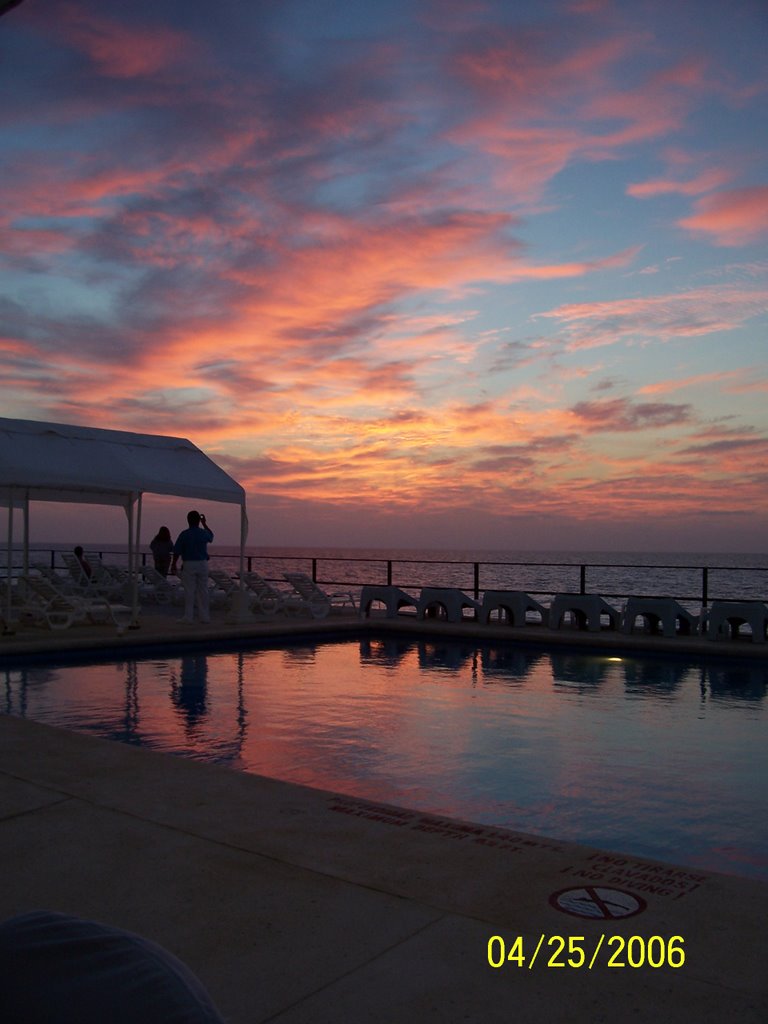
Spring break in Cancun sounds like a great idea if you live in Chicago during the brain-numbing cold of the winter months. Doing a remote from Cancun and trying to find reliable ISDN service however can be as equally mind-numbing. Clear Channel Chicago’s KISS-FM (WKSC) found this out the hard way.

This past April, the station took a bunch of its listeners down to the perennial Spring party spot for a live remote and to enjoy the beautiful beaches and incredible sunrises. There are worse things in life to be sure. Like…oh, let’s say…your remote gear getting fried! Mark Pietrzak from the engineering staff at Clear Channel Chicago had taken his trusty Matrix portable with him to Mexico but you know what they said about the best laid plans.

“Yep,” says Mark, “I hosed up my ISDN adapter. I couldn't get a straight answer about the ISDN service. For instance, what kind of switch I was dealing with, SPIDs or dialing. I did get lots of polite smiles and well-meaning shrugs. I'm chalking my failure up to inexperience in dealing with Mexican telecoms, the language barrier and the fact that it was the weekend and all the really experienced phone guys weren't in the office. The cool thing is that just about every installer and tech understood what a DSL was.”

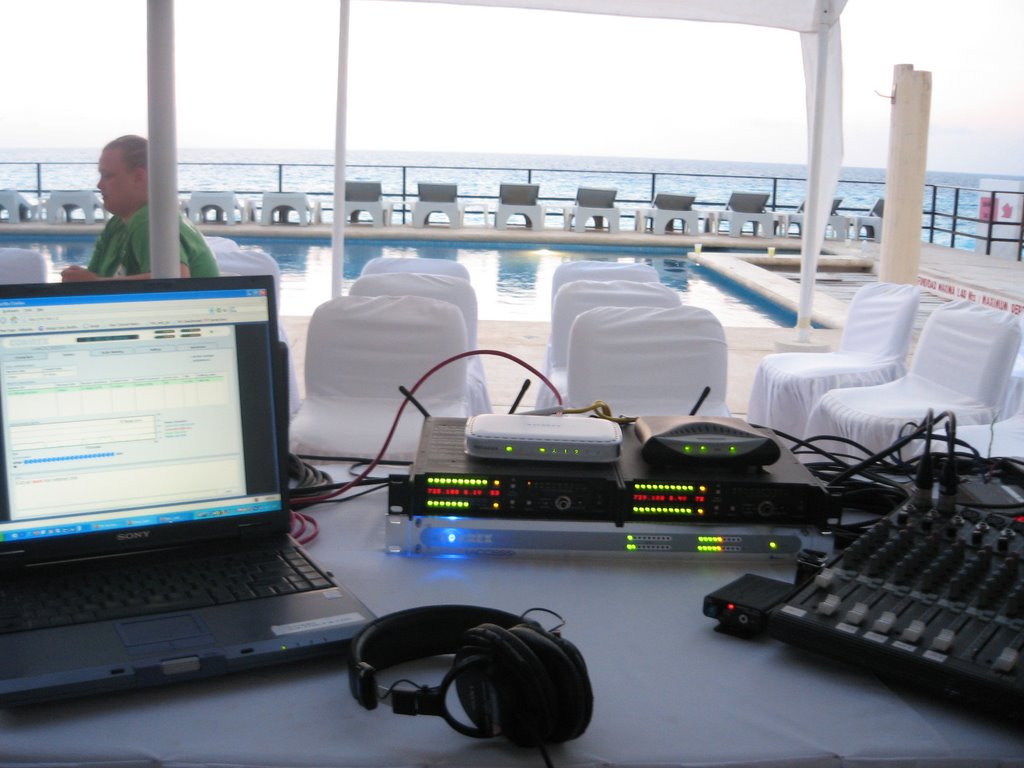
And luckily, Mark had taken along his new Comrex Access Stereo BRIC IP codec! Given the fact that Access is both POTS and IP and its ease of use, it was a great choice to have on hand. Says Mark, “We stayed off the hotel's WAN. Instead, the hotel got us a DSL which they wired to the deck outside my Promotions Director's room. Our feed from the station experienced noticeable jitter only twice during the entire show, but we heard no complaints from the station. After the show was over I plugged in my wireless router and had private wireless internet access for both me and my Promotions Director. We even won some major points with the travel agent by letting her log on. We were able to send our photos for the website right from our rooms. Our Bermuda remotes are quickly approaching. We've tested ISDN there but a rack-mount Access is definitely going along.”

As for the melted down Matrix ISDN module? No worries! Comrex Tech Support was able to get it back into working order.

Thursday, September 07, 2006

Minuteman Communications always gets their man... um... I mean, their remote


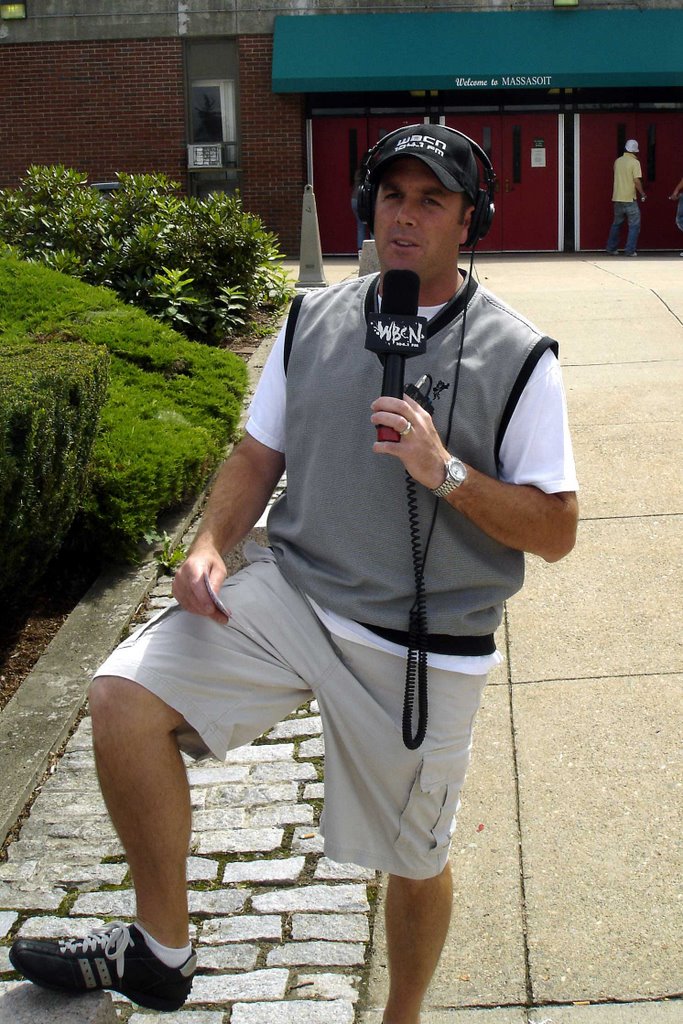
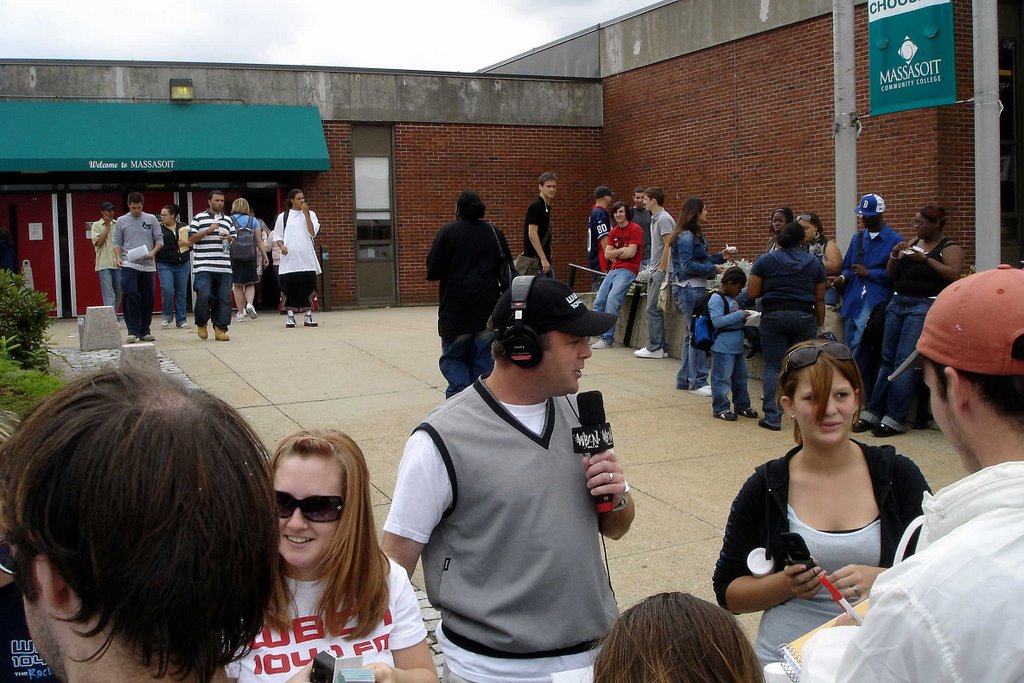
This week's impossible remote was aired on WBCN from Massasoit Community College in Brockton. John Mullaney made it happen with virtually no notice.

From John - "This was a situation where the Access was the best option. No time to order lines with the one day of notice on the remote. PBX system prevented use of POTS codec's and we where out of our RPU range. However being at a state college we snagged a wired network connection out of an office window and we were off and running. WBCN's Hardy was the Jock hosting this student lunchtime event in the Quad. I did our first cut in using Bric1 Mono and then changed to Bric2 12K mono for the second two. Everything worked out very well."

Thanks for the story, John. I'm trying to think what you would have done a year ago. Any ideas?

Wednesday, August 16, 2006

Are You Tired of STL-over-the-Public-Internet Stories Yet?

We hope not, because this story was just sent to Comrex's email, and we love it. Comrex still doesn't suggest that you use the Public Internet for an STL, because we will never completely trust the 24/7 reliability of the service. But this story does such a good, objective job of evaluating the ACCESS codec, we really felt it needed to be shared.

So here is the email, un-edited and in its entirety, from Marvin Walther, Chief Engineer for WIOS-AM, WKJC-FM, WQLB-FM and WKJZ-FM

"We originally had a fractional T1 running from our studio in Alpena, Michigan to our main broadcast center in Tawas City, Michigan, over 60 miles away. The T1 crossed LATAS for Verizon and AT&T, and was becoming cost-prohibitive (over $1,000 a month). One of our Telos Zephyrs finally gave up the ghost and was toast after 5 years of operation. The Adtran TSU 600 units and the Zephyrs have now been replaced by a router and a dedicated business com IP connection from studio to studio via Charter internet services at both locations and the Comrex Access products. We don't cross LATAS anymore, and our bill has been cut by 75% just for a broadband connection.

The Comrex Access Rack performs well on the internet connection with only 368 Kbps upload and 3 Mbps download speed. The IP is static and the Comrex units are configured to be static as well, through dedicated routers on a seperate WAN from our existing in-house internet access. Andy at Comrex was wonderful with helping me set up these units, in fact he went beyond normal working hours one evening to help me set up the recieve-studio end. Because of this dedication to their product and customer service, I'd recommend this product. It's reliable and delivers as advertised.

We are using this product as a continuing service (always on) from one studio to the other, with a bi-directional connection that provides air monitor back to the originating studio location. There are a couple of caviats you should watch for, though. In our situation the HQ2 audio codec caused too much 'swishing" of the highs of the audio to suit me. With Andy's help we changed the codec to HQ1 and the highs improved drastically, but then the midrange seemed to become more sensitive to flanging effects and midrange boosts in equalization in processing and from Rock music programming content. However, with some EQ tweeks in processing, the midrange tamed down and the MP3-like artifacts became very acceptable for a remote STL-type broadcast.

The unit has operated for nearly two weeks in the HQ1 mode without a single audio drop-out or interuption in service. The HQ2 mode, at set-up, initially had more frequent drop-outs when accessing the Access Rack via the internet browser, and when not accessed at all it had drop-outs as well. Since changing to HQ1, though, the drop-outs don't occur at all! Because of the way the Packets arrive at the reciever for reassembly, this may not be related to the Comrex product directly. Every network is dynamic, and some networks behave better with larger Packets at slower bitrates. That seems to defy logic, but given that time domains in the IP environment are always shifting, I suppose anything is possible given the type of servers and routers used, among other variables.

Another thing to watch for is to make sure your audio source material is the best you can pipe into the transmit end of the Access. Any bad-quality, or marginal MP3's will have their inherent audio flaws accented by the Access Rack in any of the HQ modes (HQ1 being the best transmission mode right out of the box with no AAC plug-in, in my humble opinion). The HQ codecs operate at different bit rates than what is found in standard MP3's, so avoid bit rates below 128 or 192 on your transmit end and don't let your jocks play audio scavenged off the internet at questionable bit-rates through the Access, you'll probably notice the effect on the air if you do.

We could have opted to roll off the highs with the 12Khz codec, but we run satellite audio after business hours, so I wanted the audio to match up as closely as possible (with either HQ1 or HQ2 having a roll-off of 15Khz) to the satellite source. We are in the process of making every single automation music track 320Kbps MP3 at full bandwidth (44.1Khz), just to be sure we are piping the best audio we can into our transmitter. Everything could be WAV file, but the music plays from a server in our Smartcaster system, so MP3 or AAC is the best option to play the audio across the network. 320Kbps does this well and performs very acceptably through the Comrex Access Rack. In the future we plan on using the Comrex Access in linear mode when we get our own IP pipeline from the studio to the transmitter, then any concerns about audio quality will be moot. However, if you have the extra money, buy the AAC codec plug-in for the Access to save you some bandwidth and improve the audio quality. I also like the fact that these units can upgrade software codecs just like a computer, and they have a bullet-proof Linux core OS so these babies can sit right on the network and not get hit by all the crazy stuff out there on the web.

Overall, the Cost versus Performance ratio is excellent. I'd recommend the Comrex Access as a great replacement option to cut costs for T1 or ISDN service and still perform acceptably for FM broadcast. If using Access for an AM STL, I would think the performance would be just as good as any standard STL. Although not designed explicitly to be an STL, right now the Comrex Access performs well as one, and I may add reliably to this point in this engineer's experience. We are now going to commit to full purchase from BSW and retire our antique fractional T1. By the time we take the additional phone circuits off our T1 as well as the T1 itself, our savings will be about $1,100 a month even after paying for the dedicated network connection through Charter internet! Thanks Comrex, for an alternative, affordable solution that finally gives the phone company a run for its money! Competition is a good thing!

Marvin Walther
Chief Engineer
WIOS-AM, WKJC-FM, WQLB-FM, WKJZ-FM
Tawas City, MI
Alpena, MI
wkjc@wkjc.com